
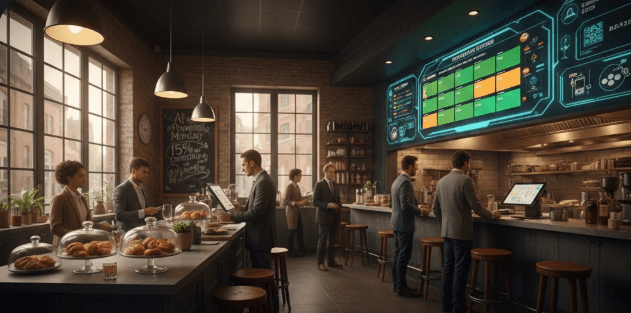
In 2026, running a restaurant or café isn’t just about great food anymore. Rising ingredient prices and a fiercely competitive labor market are squeezing profit margins from both ends. To survive—and thrive—hospitality businesses are ditching outdated, clunky systems and embracing Cloud-Based, AI-Integrated POS solutions.
Today’s POS is no longer just a payment machine. It’s a silent manager, constantly monitoring the pulse of your business in real time—tracking sales, staff efficiency, inventory, and customer behavior without ever taking a break.
1. The Core Ecosystem: Hardware vs. Software
Modern POS systems are built on two essential layers:
- Hardware – sleek tablets, card readers, handheld devices, and kitchen display screens your staff interacts with daily.
- Software – the true brain of the operation, quietly making smart decisions behind the scenes.
Cloud Connectivity
By 2026, nearly 90% of new cafés rely on cloud-based POS software. Owners can update menus, monitor sales, or check labor costs straight from their phone—whether they’re at home, on vacation, or visiting another outlet.
Offline Mode
Internet outages no longer mean lost sales. A reliable POS continues accepting orders and payments even when offline, then automatically syncs data once connectivity returns. In 2026, this feature is no longer optional—it’s essential.
2. High-Impact POS Features That Boost Profits
When choosing a POS, focus on features that directly improve efficiency and reduce waste.
A. Smart Kitchen Display Systems (KDS)
Paper tickets are officially obsolete. A Kitchen Display System replaces noisy printers with organized digital screens that prioritize orders by preparation time.
Example: If a table orders a medium-rare steak and a salad, the system intelligently fires the steak first and delays the salad—ensuring both dishes arrive perfectly together.
Result: faster service, fewer mistakes, happier customers.

B. Ingredient-Level Inventory Tracking
In cafés, every gram matters. Modern POS systems track inventory down to the ingredient level.
Sell a latte? The system automatically deducts espresso beans and milk quantities. Over time, it generates theoretical vs. actual usage reports, revealing over-pouring, waste, or even theft—before it becomes a serious problem.
C. Tableside & QR Code Ordering
Speed is king in busy cafés. With handheld mobile POS devices, staff can take orders and payments directly at the table.
This reduces unnecessary walking by up to 20%, allowing staff to focus on what truly matters: customer experience, not running back and forth to a terminal.
D. AI-Powered Predictive Analytics
In 2026, AI isn’t hype—it’s practical.
Your POS analyzes years of sales data, local weather forecasts, and nearby events to predict exactly how many staff members you need for each shift. No more overstaffing on quiet days or scrambling during surprise rushes.
3. Café vs. Full-Service Restaurant: Different Needs, Same Tech
A small espresso bar and a fine-dining restaurant operate very differently—and modern POS systems reflect that.
- Cafés need lightning-fast checkouts, simple modifiers, and digital punch-card loyalty.
- Full-Service Restaurants require detailed table management, complex coursing, allergy notes, and deep customer profiles.
The best systems adapt seamlessly to both.
4. Understanding POS Costs in 2026
A POS is an investment—not just an expense.
- Software (SaaS fees): $60–$150 per month per terminal
- Payment processing: Usually a percentage per transaction; many owners now prefer flat-rate pricing for predictable costs
- Hardware: A complete setup typically costs $800–$1,500 upfront
The right system pays for itself through efficiency, reduced waste, and better decision-making.
5. Elevating the Customer Experience
A great POS doesn’t just help owners—it delights customers.
Features like instant split bills, one-tap group payments, and even biometric payments (face or palm recognition) are becoming standard expectations in 2026.
Integrated loyalty tools allow the system to remember preferences:
“The usual flat white with almond milk today, John?”
That small moment of recognition builds powerful brand loyalty.
6. Security & Data Protection
With digital ordering on the rise, security is non-negotiable.
Ensure your POS is PCI-DSS Level 1 compliant and uses tokenization, meaning real card numbers are never stored. Even if hackers breach the system, the data is useless to them.

Final Thoughts: Choosing the Right POS
Your POS is the foundation of your hospitality business. In 2026, systems without mobile integration, AI insights, and real-time inventory tracking will fall behind faster, smarter competitors.
The smartest way to choose? Identify your biggest bottleneck during your busiest hour—whether it’s the kitchen, checkout line, or staff speed—and select a POS designed to solve that exact problem.
Because in modern hospitality, speed, intelligence, and adaptability are the real secret ingredients. 🍽️🚀

Leave a Reply