
In the fast-evolving digital landscape, Artificial Intelligence (AI) is no longer a futuristic concept—it is a present-day reality reshaping industries worldwide. One of the most significant areas of transformation is mobile app development. From personalized recommendations to intelligent automation, AI is revolutionizing how mobile applications are designed, developed, and experienced.
As businesses compete in an increasingly mobile-first world, integrating AI into mobile applications has become a strategic necessity rather than an optional enhancement. In this article, we explore how AI is transforming mobile app development, the technologies driving this change, and why businesses and developers must adapt to stay competitive.
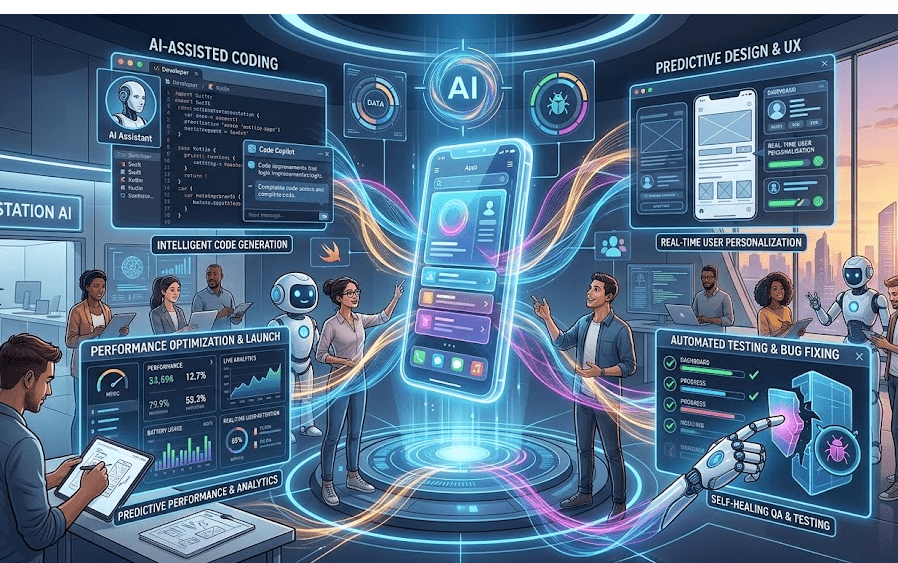
The Evolution of Mobile App Development
Traditional mobile app development focused primarily on functionality and user interface design. Apps were built to perform predefined tasks based on static programming logic. While effective, these applications lacked adaptability and personalization.
Today, AI-powered mobile apps go beyond fixed instructions. They learn from user behavior, analyze data patterns, and continuously improve performance. This shift from static to intelligent systems marks a significant transformation in the mobile app development lifecycle.
AI-driven apps can:
- Analyze user preferences in real time
- Predict future behavior
- Automate customer support
- Enhance app security
- Optimize user experience (UX)
The integration of AI technologies has elevated mobile apps from simple tools to smart digital assistants.
Key Ways AI is Transforming Mobile App Development
1️⃣ Personalized User Experience
One of the biggest impacts of AI in mobile app development is hyper-personalization. Modern users expect apps to understand their needs and deliver customized experiences.
AI algorithms analyze user interactions, browsing history, location data, and engagement patterns to provide tailored content and recommendations. Whether it is e-commerce product suggestions, curated playlists, or personalized learning modules, AI ensures that each user receives a unique experience.
This level of personalization significantly improves:
- User engagement
- Customer retention
- Conversion rates
- Customer satisfaction
Personalized mobile experiences are now a critical ranking factor in app store optimization (ASO) and digital marketing success.

AI-Powered Chatbots and Virtual Assistants
Customer experience is a core pillar of successful mobile applications. AI-powered chatbots and virtual assistants have transformed how businesses interact with users.
Using Natural Language Processing (NLP), AI chatbots can:
- Understand user queries
- Provide instant responses
- Handle customer support requests
- Automate booking and purchasing processes
This reduces operational costs while improving customer satisfaction. Mobile apps in sectors such as healthcare, fintech, retail, and education increasingly rely on AI-driven communication systems.
3️⃣ Predictive Analytics and Smart Decision-Making
Predictive analytics is another major innovation driven by AI in mobile app development. By analyzing large volumes of data, AI models can forecast user behavior and trends.
For example:
- E-commerce apps predict products users are likely to purchase
- Fitness apps suggest customized workout routines
- Financial apps detect fraudulent transactions
- Streaming platforms recommend content based on viewing habits
Predictive capabilities allow businesses to make data-driven decisions and improve overall app performance.
4️⃣ Enhanced Mobile App Security
As mobile usage increases, cybersecurity threats continue to grow. AI plays a critical role in strengthening mobile app security through advanced threat detection and prevention systems.
AI-powered security features include:
- Biometric authentication (face recognition, fingerprint scanning)
- Fraud detection algorithms
- Behavioral anomaly detection
- Real-time risk analysis
By continuously monitoring user behavior, AI systems can detect suspicious activities and prevent security breaches before they escalate.
Security is a top priority in mobile app development, and AI significantly enhances trust and compliance standards.
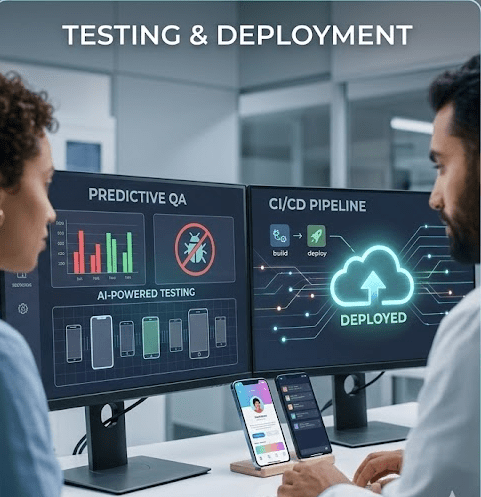
5️⃣ Intelligent Automation in App Development
AI is not only transforming user experience but also improving the mobile app development process itself.
Developers now use AI-powered tools for:
- Automated code generation
- Bug detection and debugging
- Performance optimization
- UI/UX improvement suggestions
- Automated testing
AI-assisted development reduces time-to-market, improves code quality, and increases efficiency in agile development environments.
For project managers and product teams, AI tools enable better sprint planning, risk prediction, and resource allocation.
Technologies Driving AI in Mobile App Development
Several advanced technologies power AI-driven mobile applications:
- Machine Learning (ML) – Enables apps to learn from data and improve over time
- Natural Language Processing (NLP) – Supports chatbots and voice assistants
- Computer Vision – Enables image recognition and augmented reality features
- Deep Learning – Enhances complex pattern recognition
- Cloud AI Services – Provide scalable infrastructure for AI models
Frameworks like TensorFlow Lite, Core ML, and cloud-based AI APIs allow seamless AI integration into Android and iOS applications.
The combination of AI and cross-platform frameworks like Flutter and React Native is accelerating innovation in mobile app development.
Business Impact of AI in Mobile Applications
AI integration in mobile app development delivers measurable business benefits:
✅ Increased User Engagement
AI-driven personalization keeps users active and reduces churn rates.
✅ Higher Revenue Growth
Smart recommendations and targeted marketing improve sales performance.
✅ Operational Efficiency
Automation reduces manual workloads and support costs.
✅ Competitive Advantage
AI-powered features differentiate apps in crowded marketplaces.
✅ Data-Driven Innovation
Businesses gain valuable insights from real-time analytics.
Companies that leverage AI strategically in their mobile apps achieve long-term scalability and sustainable growth.
The Future of AI in Mobile App Development
The future of mobile app development lies in intelligent ecosystems. Emerging innovations include:
- Emotion recognition through facial analysis
- Real-time voice-based interactions
- AI-driven augmented reality (AR) applications
- Context-aware mobile experiences
- Autonomous mobile systems
As 5G technology expands globally, AI-powered mobile applications will become faster, more responsive, and more sophisticated.
For developers, learning AI integration skills is no longer optional—it is essential for career growth. For business leaders, investing in AI-driven mobile strategies is crucial to staying ahead in digital transformation.
Final Thoughts
Artificial Intelligence is fundamentally transforming mobile app development by making applications smarter, more secure, and highly personalized.
From predictive analytics to intelligent automation, AI is reshaping both the development lifecycle and user experience. Businesses that embrace AI-powered mobile app development today will lead tomorrow’s digital economy.
The real transformation is not just technological—it is strategic.
The future belongs to intelligent apps.
Are you ready to build them?



Leave a Reply