
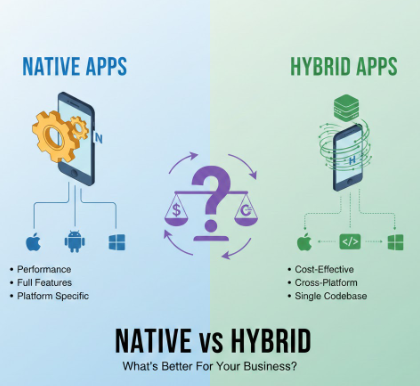
When planning a mobile app, one of the first and most important decisions you’ll face is choosing how the app will be built. You may hear terms like Native app, Hybrid app, React Native, or Flutter — and for non-technical business owners, this can be confusing.
This article explains these options in plain, easy-to-understand language, helping you choose the best approach for your business goals, timeline, and budget.
What Is a Native App?
A native app is built specifically for one platform:
- iOS apps use Swift or Objective-C
- Android apps use Kotlin or Java
Key characteristics:
- Built separately for iOS and Android
- Uses platform-specific tools
- Offers best performance and stability
Advantages of Native Apps:
- Excellent performance and speed
- Full access to device features (camera, GPS, Bluetooth)
- Smooth user experience
- Strong security
Disadvantages:
- Higher development cost
- Longer development time
- Two separate apps to maintain
Best for:
- Large businesses
- Apps with heavy performance needs
- Gaming apps
- Complex enterprise systems
What Is a Hybrid App?
A hybrid app uses a single codebase that works on both iOS and Android. Two of the most popular hybrid frameworks today are React Native and Flutter.
Hybrid apps are widely used by startups and small-to-medium businesses due to their speed and cost efficiency.
What Is React Native?
React Native is a hybrid framework developed by Facebook (Meta). It uses JavaScript and allows developers to build apps that feel almost like native apps.
Advantages of React Native:
- One codebase for iOS and Android
- Faster development time
- Lower cost compared to native apps
- Strong community support
- Near-native performance
Disadvantages:
- Slightly lower performance than native
- Some features still require native code
- Depends on third-party libraries
Best for:
- Business apps
- POS systems
- Booking apps
- E-commerce apps
- MVP development
What Is Flutter?
Flutter is a hybrid framework developed by Google. It uses the Dart programming language and is known for beautiful UI designs and fast performance.
Advantages of Flutter:
- Single codebase for both platforms
- High performance close to native
- Custom, smooth UI animations
- Consistent design across devices
- Fast development
Disadvantages:
- Smaller developer pool than React Native
- Larger app size
- Dart language learning curve
Best for:
- Startups
- Visually rich apps
- Apps needing custom UI
- Rapid prototyping
Native vs React Native vs Flutter: Quick Comparison
Feature Native React Native Flutter Platforms Separate apps iOS & Android iOS & Android Cost High Medium Medium Development Time Slow Fast Fast Performance Excellent Very Good Very Good UI FlexibilityPlatform-basedModerateHighMaintenanceComplexSimpleSimple
Which Option Is Best for Your Business?
Choose Native if:
- You need maximum performance
- Your app uses advanced device features
- You have a large budget
- You want platform-specific UI
Choose React Native if:
- You want faster launch
- You want lower development cost
- Your app is business-focused
- You plan frequent updates
Choose Flutter if:
- UI design is a top priority
- You want smooth animations
- You want consistent look on all devices
- You want rapid development
Cost and Timeline Comparison
Native Apps:
- Cost: High
- Timeline: 4–6 months
React Native / Flutter Apps:
- Cost: Budget-friendly
- Timeline: 2–3 months
Hybrid apps can reduce development costs by up to 40–50% compared to native apps.
Common Business Use Cases for Hybrid Apps
Hybrid apps are perfect for:
- Restaurants & cafés
- POS systems
- Booking platforms
- Service-based businesses
- Retail stores
- Startups and MVPs
Many popular apps today use hybrid technology to scale quickly.
Future-Proofing Your App
Hybrid frameworks like React Native and Flutter are continuously improving. With strong support from Meta and Google, these platforms are considered safe long-term choices for business apps.
Final Thoughts
There is no one-size-fits-all answer when choosing between native and hybrid apps. The right choice depends on your business size, budget, timeline, and app complexity.
For most small and medium businesses, hybrid apps using React Native or Flutter offer the best balance between cost, performance, and speed. Native apps are ideal for advanced use cases but come with higher costs.
The key is to choose a development partner who understands your business needs and recommends the right technology — not the most expensive one.




Leave a Reply